Modern Foreign Languages
MFL AND INTERNATIONAL WORK CURRICULUM
Our Modern Foreign Languages Subject Leader and International Work Co-ordinator is Madame Byrne.
Vision
Learning another language has many benefits for both the individual and the wider community. It helps to break down social barriers and encourages cross-cultural understanding, as well as helping the individual to boost their problem solving, memory, critical thinking and listening skills. Being able to speak a second language also helps improve understanding of areas such as grammar in their native language.
Curriculum
|
The French Curriculum will: |
|


|
Current Year 6 with letters from their French penfriends | [pdf 2MB] |

|
Intent
The intent of the French curriculum at Wragby Primary School is that children are taught to develop an interest in learning other languages in a way that is enjoyable and stimulating.
It is our intention to ensure that by the end of our children’s primary education, they have acquired an understanding of both spoken and written French, confidence to speak in French with others and know how important other languages can be in their future.
We encourage children’s confidence and we strive to stimulate children’s curiosity about the way languages work.
We strive to embed the skills of listening, speaking, reading and writing necessary to enable children to use and apply their French learning in a variety of contexts and lay the foundations for future language learning.
Our MFL curriculum is designed to progressively develop children’s skills in languages, through regular taught lessons. Pupils throughout the school receive weekly language lessons delivered by a specialist in French, lasting between 45 minutes and I hour 10 minutes, depending on age.
We concentrate on speaking and listening skills in Key Stage 1 and then as children progress through Key Stage 2, they start to develop reading and writing skills.
Children progressively acquire, use and apply a growing bank of vocabulary organised around topics as well as building up their grammatical knowledge about how the language works.
We have achieved the full International Schools Award and consequently our international work is thoroughly imbedded in the language curriculum.
We have a number of partner schools and children regularly correspond with their penfriends, giving them a real audience for their language learning and an opportunity to compare different cultures.
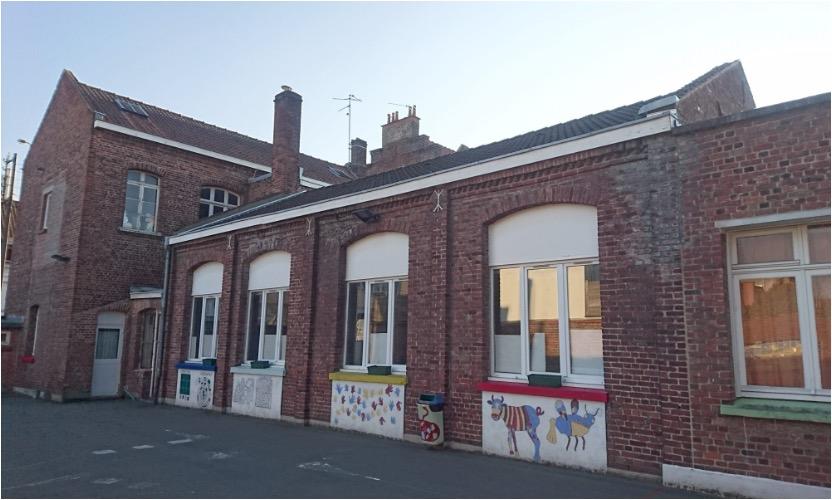
Our French partner school in Lambersart, Lille, France.
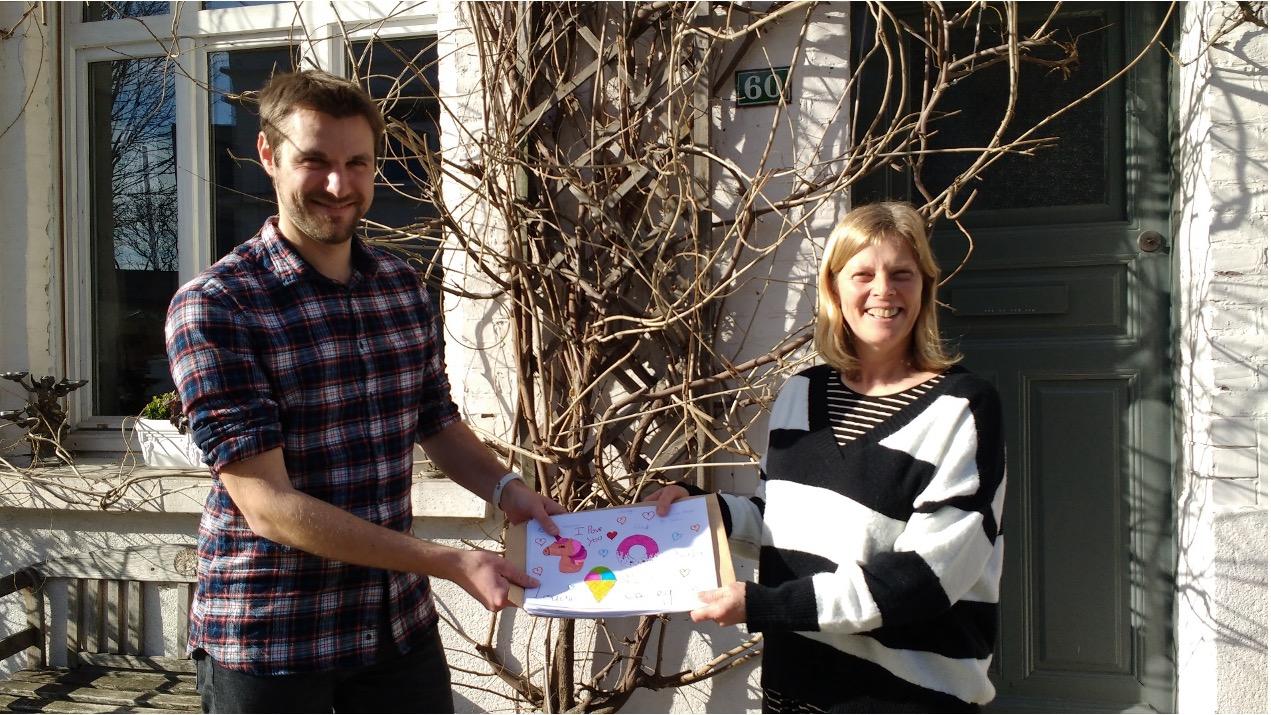
Madame Byrne handing over the children’s work to Monsieur Noël, the headteacher.
Implementation
French lessons include presentation of the language in an engaging way, through games and songs, which require repetition of the language thus developing correct pronunciation and aiding memory recall.
The new vocabulary along with appropriate grammar rules are then used to good effect in all four skills of listening, speaking, reading and writing.
Activities include:
• learning French vocabulary
• asking and answering questions, and following instructions in French
• reinforcing memory with mime and physical actions
• playing games and learning songs
• video clips
• using bilingual dictionaries
• teaching of basic French grammar, sentence structure and spelling patterns
• learning French phonics
• researching and learning about life in France and other French-speaking countries
• writing phrases and sentences
Impact
Our MFL curriculum will ensure all pupils develop key language learning skills set out by the national curriculum, as well as a love of languages and learning about other cultures.
By the end of their primary education, they will be able to:
- understand and respond to spoken and written language from a variety of a sources
- speak with increasing confidence, fluency and spontaneity, finding ways of communicating what they want to say and continually improving the accuracy of their pronunciation and intonation
- to be able to write at varying length, for different purposes and audiences, using the variety of grammatical structures that they have learnt
We measure the impact of our MFL curriculum in a variety of ways including:
- Observing children speaking and listening in the language
- Marking written work
- Images and videos of children completing speaking and listening tasks
Progression is tracked from Years 3 to 6 using both informal and formal assessment to gauge pupils’ understanding.
The MFL subject leader will continually monitor the impact MFL teaching is having on the children’s learning, through work scrutiny, to ensure the progress of knowledge and skills is being taught. They will also ensure the knowledge taught is retained by the children and continually revisited and that the learners are able to apply the skills they have been taught to a variety of different settings, showing independence with their learning.
Consequently pupils at Wragby Primary School have an excellent grounding in French to allow them to make positive gains in their learning beyond primary school.
|
|
MFL AND INTERNATIONAL WORK CURRICULUM INTENT WRAGBY PRIMARY SCHOOL | [pdf 49KB] |
|
|
|
Long Term Planning Scheme of work Reception | [pdf 80KB] |
|
|
|
Long Term Planning Scheme of work Year 1 | [pdf 87KB] |
|
|
|
Long Term Planning Scheme of work Year 2 | [pdf 88KB] |
|
|
|
Long Term Planning Year 3.doc | [pdf 30KB] |
|
|
|
Long Term Planning Year 4 | [pdf 28KB] |
|
|
|
Long Term Planning Year 5 | [pdf 38KB] |
|
|
|
Long Term Planning Year 6 | [pdf 30KB] |
|